
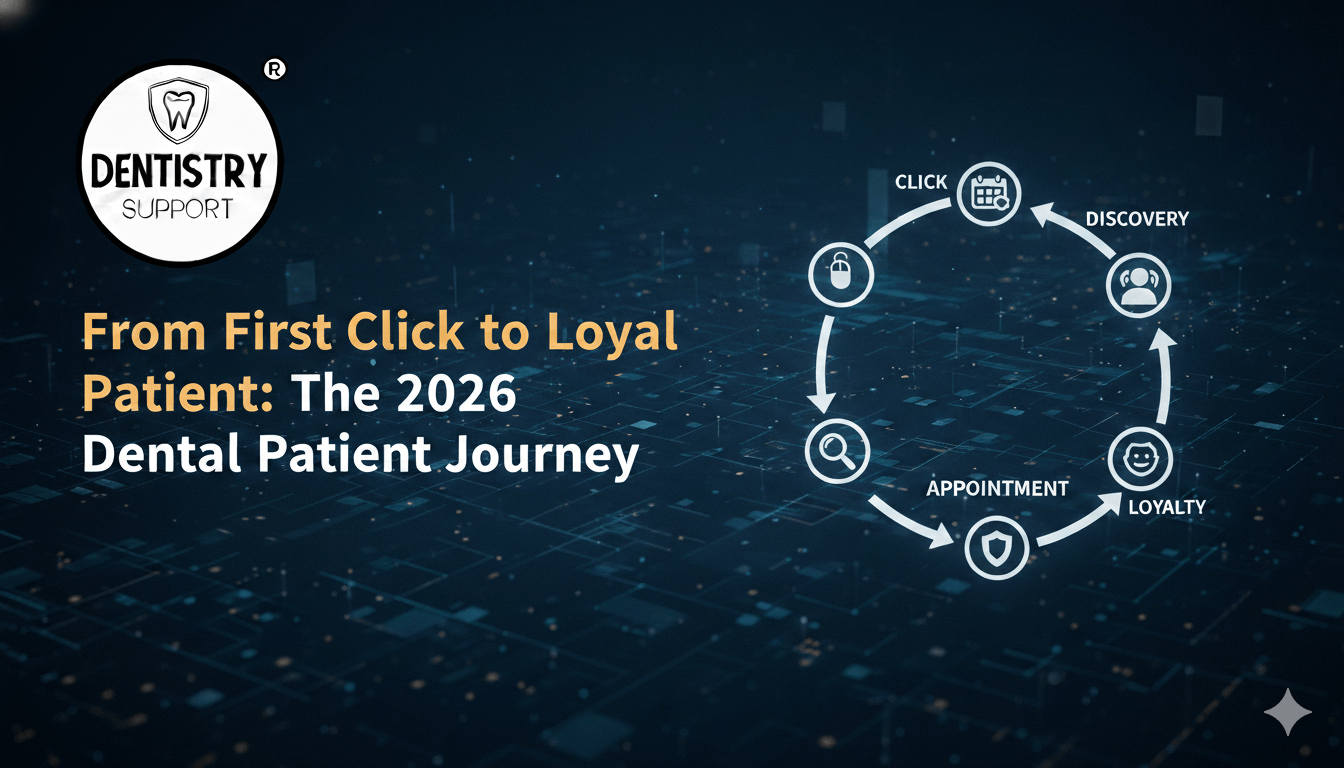
From First Click to Loyal Patient: The 2026 Dental Patient Journey—A Systems‑First Approach from Dentistry Support®
A Message From Dentistry Support®, in Partnership With Search Everywhere Marketing (SEM)
This free resource is designed to help dental practices strengthen operations, reduce overhead, and prepare for consistent, predictable patient growth.
Modern dental patients no longer move through a simple, linear decision path. They search, compare, research, evaluate, return later, ask AI, read reviews, check social media, visit your website, and only then—if everything feels aligned—they book.
But here’s what Dentistry Support® has learned after supporting thousands of practices:
Most dental patient journeys break down internally—not externally.
Not because marketing is bad… but because the operational system underneath cannot support the journey.
This blog reframes the modern patient journey through a systems-first lens, showing how Dentistry Support® stabilizes the internal workflow and how SEM accelerates growth once the foundation is strong.
Why Today’s Dental Patients Follow a Nonlinear Journey
According to recent research, modern healthcare consumers interact with 7–13 digital touchpoints before booking (Kemp et al., 2023).
These include:
- Google Search
- Reviews
- Social media
- Blogs
- Website visits
- Short‑form video
- Email nurturing
- Retargeting exposures
Patients today circle, bounce, repeat steps, and come back later when they’re confident in the choice.
This is why consistency and cohesion matter.
But consistency only happens when your internal systems support the external experience.
Stage 1: Awareness — “I Just Found You”
Patients discover you through:
- Google business listings
- SEO visibility
- Social content
- Short‑form video
- Local presence
But awareness only helps IF your phone team, eligibility checks, and admin systems can support new demand.
Dentistry Support® Action Tip:
Audit your Google Business Profile weekly: Are you posting? Are photos current? Is your hours section accurate?
Stage 2: Consideration — “Should I Choose You?”
Patients compare 2–4 providers (as noted directly on page 2 of the guide). fileciteturn4file1
They evaluate:
- Website clarity
- Treatment explanations
- Brand professionalism
- Educational content
- Online reviews
This is where many practices lose patients—not due to marketing, but due to inconsistent messaging, outdated websites, or unclear communication.
Dentistry Support® Action Tip:
Have one team member perform a “pretend patient” test monthly and document:
- Was the phone answered?
- Was the website clear?
- Were fees or next steps easy to understand?
- Did reviews feel recent and trustworthy?
Stage 3: Conversion — “I’m Ready to Book”
This stage is where systems matter most.
Patients expect:
- Fast follow‑up (within 5–10 minutes)
- Easy scheduling
- Text communication
- Helpful answers
The Conversion section on page 3 shows exactly how important speed and clarity are. fileciteturn4file1
Dentistry Support® Action Tip:
Implement a simple 3‑step same‑day follow‑up system:
- Immediate text reply for missed calls
- Call back within 5 minutes
- 48‑hour reminder if no response
Practices with structured follow‑up convert 2–5x more leads (Taneja et al., 2022).
Stage 4: Loyalty — “I Trust You and I’m Coming Back”
Retention requires consistency—something most practices struggle with because their admin team is already overwhelmed.
Patients stay loyal when they receive:
- Reactivation reminders
- Monthly educational emails
- Regular social engagement
- Excellent in‑office experience
On page 3 of the guide, the Loyalty stage emphasizes ongoing communication. fileciteturn4file1
Dentistry Support® Action Tip:
Create a 12‑month communication calendar:
- 1 newsletter/month
- 1 educational email/month
- 1 recall/rehygiene automation/month
- 2 review‑request prompts/month
Why Most Dental Funnels Break
Most practices lose patients due to:
- Weak Google visibility
- Irregular posting
- No short‑form video presence
- Low review volume
- Poor follow‑up speed
- Lack of automated workflows
But here’s the real insight:
These gaps are NOT marketing problems.
They are operational problems.
If phones aren’t answered, eligibility is inconsistent, or admin bandwidth is low—no marketing system can compensate.
Where Dentistry Support® Fits In
Dentistry Support® strengthens the foundation of the patient journey by:
- Answering phones consistently
- Cleaning billing and eligibility
- Reducing overhead
- Managing admin workflows
- Sending daily recaps
- Ensuring patients receive a predictable experience
This makes every stage of the funnel stronger.
Only when the internal systems are unified and stable do we introduce patients to SEM.
Where SEM Fits In (Only When You’re Ready)
SEM activates one unified omnipresence system:
- Google visibility
- Social presence
- Educational content
- Website clarity
- Automated follow‑up
- Reputation building
SEM is the external engine.
Dentistry Support® is the internal engine.
Together, they create predictable growth.
Free Resource: Dental Patient Journey Map (2026 Edition)
To help your team understand how patients move through your blueprint, download:
Drop the word ‘LOYAL‘ in the chat widget on this page and we’ll send it right away.
This guide includes:
- A visual breakdown of every stage (as seen across pages 1–5) fileciteturn4file1
- Real examples of patient touchpoints
- Where practices commonly lose leads
- How DS + SEM strengthen each part
- A simple training tool for your entire team
Final Thoughts
Patients today want clarity, consistency, professionalism, and connection.
Dentistry Support® creates the operational consistency.
SEM amplifies that consistency into predictable growth.
If you want to strengthen the patient journey without increasing your team’s workload, explore our DS → SEM unified system:
References
Kemp, E., Sweet, C., & McCracken, C. (2023). Digital trust‑building and the multi‑touch healthcare consumer journey. Journal of Medical Marketing, 23(1), 45–59.
Taneja, S., Arora, A., & Maheshwari, S. (2022). Impact of structured follow‑up on patient conversion rates in outpatient healthcare. Healthcare Management Review, 47(4), 302–310.