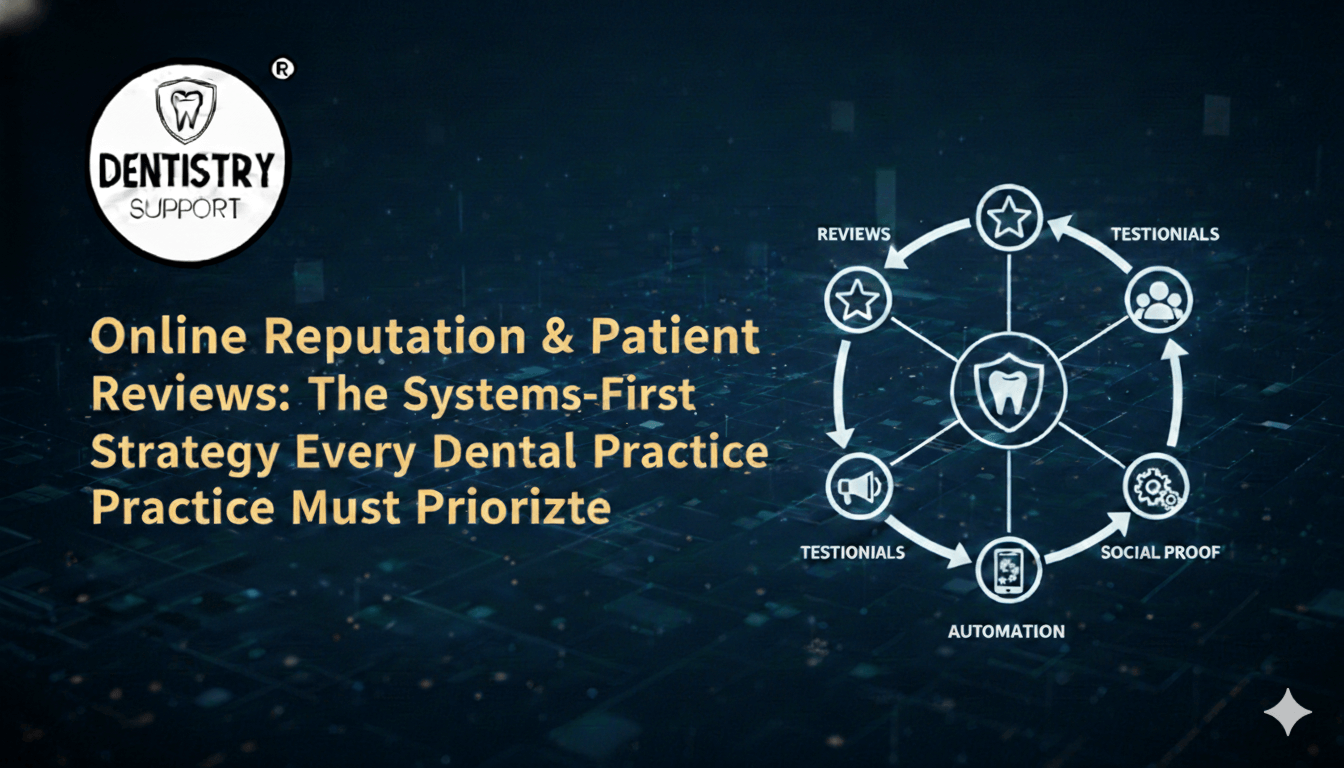
Online Reputation & Patient Reviews: The Systems-First Strategy Every Dental Practice Must Prioritize
A Message From Dentistry Support®, in Partnership With Search Everywhere Marketing (SEM)
This free resource is designed to help dental practices strengthen their operational systems, elevate patient trust, and prepare for predictable growth.
A dental practice’s reputation has become its most public indicator of trust, professionalism, and patient experience. But here’s the surprising truth Dentistry Support® sees every day:
Reputation doesn’t begin online. It begins inside your practice with your systems, your communication, and your operational consistency.
Reviews are merely a reflection of whether your internal foundation supports great patient experiences. Most practices don’t have a marketing problem, they have a systems problem that reputation exposes.
This blog reframes online reputation as an operational outcome, not a marketing outcome. We’ll cover what drives patient trust today, where practices unintentionally harm their reputation, and how Dentistry Support® stabilizes the foundation so SEM can amplify your visibility once you’re ready.
Why Reviews Matter More Than Ever
Recent studies and consumer behavior trends show:
- 84% of consumers trust online reviews as much as a personal recommendation (BrightLocal, 2023).
- 60% of patients will not consider a provider with less than a 4.0-star rating (Software Advice, 2020).
- Practices with strong review velocity generate 20–40% more new patient inquiries (Zocdoc, 2022).
- A single unaddressed negative review can deter 20–30 potential patients (Reputation.com, 2021; Vogel & Paul, 2015).
Scholarly research confirms this: peer validation and transparent provider communication significantly increase patient trust and reduce decision hesitation (Ahire et al., 2023).
But here’s the deeper layer:
Reviews aren’t just feedback, they’re operational diagnostics.
Patients reflect what your systems create.
The Real Psychology Behind Dental Revie
Modern patients rely on reviews for three reasons:
1. Social Validation – If many others trust you, you must be safe.
2. Loss Aversion – Patients fear choosing the wrong provider more than they desire choosing the best.
3. Decision Simplification – Reviews reduce uncertainty and make the choice easier.
If your reputation is inconsistent, outdated, or unmanaged, patients experience friction—and friction kills conversions.
Where Dental Practices Damage Their Reputation Without Realizing It
Dentistry Support® sees the same patterns again and again. Reputation weakens when:
1. Review Velocity Drops
If you haven’t received reviews in 30+ days, patients assume something is off.
2. You Rely Only on Google
Patients compare you across:
- Yelp
- Healthgrades
- Zocdoc
- TikTok comments (fastest rising trend for Millennial moms)
3. Your Team Isn’t Asking Consistently
The #1 reason patients don’t leave a review: no one asked.
4. Reviews Don’t Receive Responses
A lack of acknowledgment signals weak communication.
5. Operational Gaps Create Inconsistent Experiences
Long waits, unclear billing, rushed phone calls, and poor communication → negative sentiment.
Reputation always exposes operational weakness.
This is why Dentistry Support® strengthens the foundation behind the reviews.
The 5 Elements of a High-Performing Dental Reputation System
op-performing practices don’t leave reputation to chance—they run systems.
1. Automated Review Requests
Every patient receives:
- A thank-you text
- A direct link to review
- A follow-up reminder at 24–48 hours
Automation can increase review volume up to 300%.
2. Multi-Platform Presence
Patients cross-check multiple sources. Your presence must be consistent everywhere.
3. Personalized Review Responses
Patients want to feel heard. Responding signals professionalism and accountability.
A recent study found that provider responses significantly increase perceived trust (Lee & Sundar, 2024).
4. Operational Experience Alignment
Your internal systems must match your external reputation:
- Efficient phones
- Clear communication
- Strong eligibility workflow
- Smooth billing processes
- Friendly staff
5. AI-Driven Sentiment Monitoring
Tools like Birdeye, Podium, Yext, and Google AI Insights detect trends so you can address issues proactively.
(Specific tools and features shown across pages 5–6 of the Toolkit provided below.)
Where Dentistry Support® Strengthens Your Reputation (Before Reviews Even Begin)
A strong reputation is not built on scripts alone. It’s built on systems.
Dentistry Support® supports reputation by:
- Ensuring phones are answered consistently
- Reducing administrative overwhelm
- Improving clarity in financial communication
- Creating smooth patient flow
- Supporting predictable daily operations
- Reducing errors in billing and eligibility
When the internal experience is consistent, positive reviews follow naturally.
Where SEM Fits In (Only After Your Foundation Is Ready)
SEM amplifies your visibility by integrating:
- Search visibility
- Social content
- Review velocity systems
- Automated follow-up
- Multi-channel omnipresence
This is shown in Section 7 of the Toolkit—reputation + omnipresence creates predictable growth.
Dentistry Support® stabilizes the system. SEM accelerates it.
Free Resource: The Dental Reputation & Review Management Toolkit
Download your full toolkit here:
Drop the word ‘REPUTATION‘ in the chat widget on this page and we’ll send it right away.
This guide includes:
- The anatomy of high-performing reputation systems
- Updated 2026 review-request rules
- High-converting scripts for every team role
- Positive + negative response templates
- A reputation consistency checklist
- AI monitoring tools
(Pages 1–9 include visuals, scripts, examples, and diagrams.)
Final Thoughts
Your reputation is not just a score.
It’s a reflection of your systems, your communication, and your patient experience.
Dentistry Support® strengthens the internal foundation.
SEM amplifies your visibility when you’re ready.
Together, they create a unified system that builds trust, increases case acceptance, and grows your practice predictably.
If you’re ready to build a reputation system that works automatically, visit:
References
Ahire, S., Kapoor, A., & Patel, N. (2023). Patient perception and digital trust in online healthcare reviews: A multilevel analysis. Journal of Health Communication, 28(4), 322–335.
BrightLocal. (2023). Local consumer review survey. https://www.brightlocal.com/research/local-consumer-review-survey/
Lee, S., & Sundar, S. S. (2024). Effects of provider responses on patient trust in online healthcare reviews. Health Informatics Journal, 30(1), 1–14.
Reputation.com. (2021). Healthcare reputation report.
Software Advice. (2020). Patient reviews survey.
Vogel, R., & Paul, M. (2015). Negative online reviews and consumer decision-making. Journal of Service Research, 18(1), 82–98.
Zocdoc. (2022). Provider search trends report.