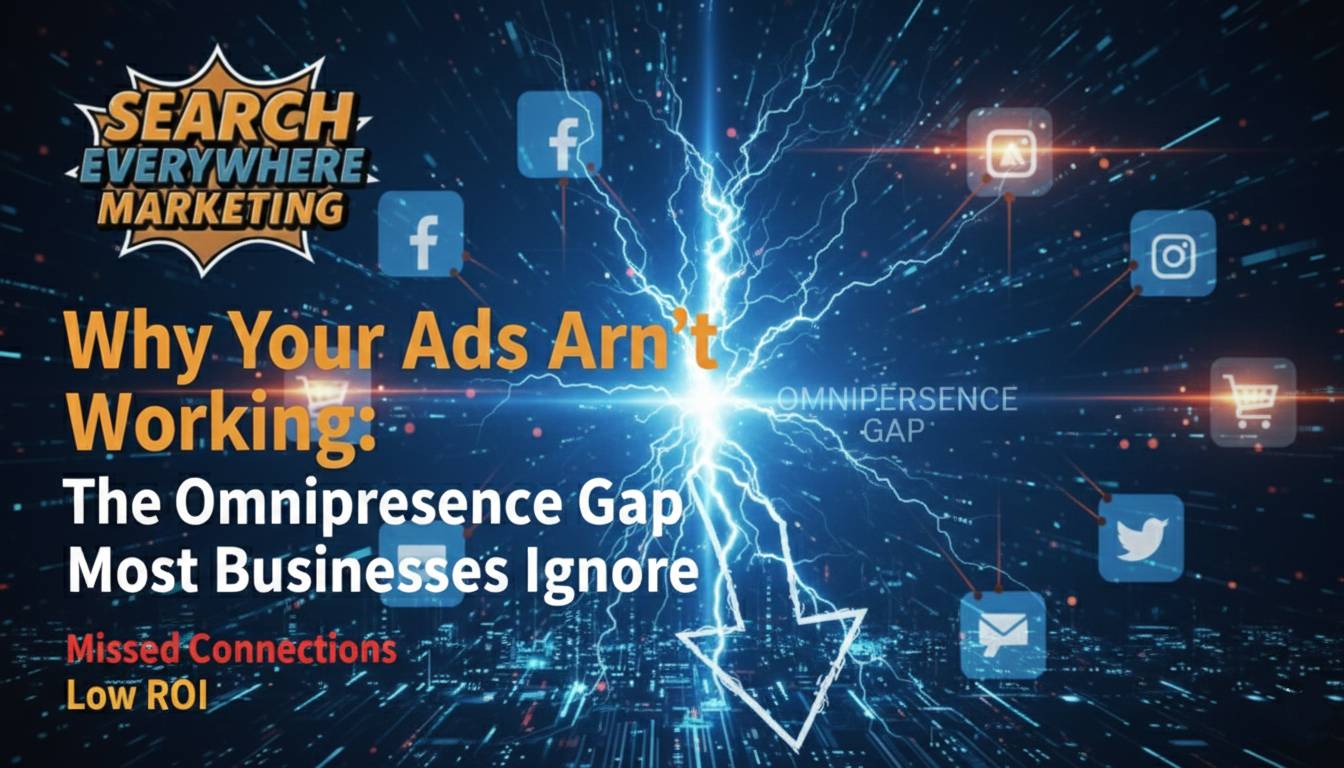
Why Your Ads Aren’t Working: The Omnipresence Gap Most Businesses Ignore
When ad campaigns underperform, the first instinct is usually tactical. Businesses review targeting settings, adjust budgets, swap out creative, or move to a different platform altogether. It feels logical to assume that if results are weak, the issue must be something inside the ad account.
Yet in many cases, the real problem isn’t the ad.
It’s the absence of structured visibility.
Clicks without conversions often signal what we call the omnipresence gap — the distance between being seen once and being seen consistently enough to be trusted.
🔍 The Problem with Isolated Campaigns
Most marketing efforts are built as standalone initiatives. A business runs paid search. Later, they tested paid social media. Maybe retargeting is added after the fact. Each channel operates independently, without a unified structure.
When campaigns are built this way, every ad is expected to do too much. It must introduce the brand, build credibility, overcome objections, and close the sale in one interaction.
But that is not how buyers behave.
Modern buyers rarely make decisions after a single touchpoint. In many B2B environments, research suggests buyers interact with a brand dozens of times before committing (Coalition Technologies, 2025). Even in consumer markets, repeated exposure increases familiarity and lowers perceived risk.
If someone sees your brand once and never again, they are unlikely to convert. Not because your offer is weak, but because trust was never given time to develop.
🔄 Understanding the Omnipresence Gap
The omnipresence gap exists when visibility is inconsistent.
Your competitors appear in search results. They show up in social feeds. They run video content. They retarget visitors. They reinforce their message across platforms.
You run a single campaign.
Over time, familiarity builds for them — not for you.
Familiarity creates authority. Authority builds trust. And trust drives action.
When that layered visibility is missing, ads generate traffic but fail to produce revenue. The system lacks reinforcement.
🎯 Why Platforms Get Blamed
When campaigns stall, it is common to blame the platform.
“Facebook leads are low quality.”
“Google Ads are too expensive.”
“Our audience just isn’t responding.”
But if competitors in your industry are converting on the same platforms, the channel is unlikely to be the root issue.
More often, performance suffers because marketing efforts are not aligned to buyer psychology. Awareness, consideration, and decision stages are not clearly structured. Messaging is not sequenced. Retargeting is inconsistent.
Without coordinated omnipresence, each campaign fights alone.
🧠 The Role of Repetition in Buyer Psychology
Psychology supports what experienced marketers already know: repeated exposure builds preference. The mere exposure effect demonstrates that people are more likely to trust and choose brands they recognize.
Omnipresence is not about being everywhere randomly. It is about appearing intentionally across the platforms your audience uses, with messaging that evolves as their awareness deepens.
💡 Awareness content introduces the problem.
🏆 Mid-funnel messaging reinforces credibility.
🔁 Retargeting removes doubt.
🔎 Search captures active demand.
When those elements work together, ad performance becomes more stable and predictable.
When they do not, businesses experience fluctuating results and inconsistent conversion rates.
🔗 Closing the Visibility Gap
Improving ad performance often requires stepping back from the ad itself and evaluating the system behind it.
Consider the following:
- Are potential buyers seeing your brand more than once?
- Is there a deliberate retargeting sequence in place?
- Does your mid-funnel messaging reinforce proof and authority?
- Are search, social, and video working together instead of operating in silos?
- Is the path from awareness to decision structured intentionally?
If the answer to these questions is unclear, the issue may not be creative quality or budget size. It may be incomplete visibility.
Closing the omnipresence gap does not necessarily require doubling ad spend. It requires coordination. Sequencing. Reinforcement. A system that reflects how buyers actually decide.
📋 Takeaways
When ads fail to convert, the underlying issue is often structural, not tactical.
Most campaigns underperform because they operate in isolation. A single ad cannot carry the entire weight of persuasion. Buyers move gradually from awareness to confidence, and that progression requires layered exposure.
When visibility is coordinated across platforms and aligned with buyer psychology, conversions become more predictable. Awareness builds recognition. Repetition builds trust. Reinforcement builds confidence.
That is the difference between isolated campaigns and omnipresence.
If you want to evaluate whether your marketing system truly supports how buyers make decisions, you need more than ad metrics. You need a framework that maps visibility to psychology.
At Search Everywhere Marketing, we build coordinated omnipresence systems that connect search, social, video, and retargeting into one structured experience. To help businesses assess where their visibility may be breaking down, we created the Buyer Psychology Ecosystem Checklist.
This checklist helps you identify:
- Where your brand is building awareness
- Whether trust is reinforced through repeated exposure
- Which credibility signals may be missing
- Where friction is interrupting the buyer journey
- How retargeting supports, or weakens, your visibility strategy
Many businesses discover their ads are not broken. Their visibility system is incomplete.
If you want to determine whether you have a platform problem or an omnipresence gap, download the Buyer Psychology Ecosystem Checklist and review your marketing step by step.
References
Coalition Technologies. (2025, May 15). How many touches does your B2B buyer need? https://www.coalitiontechnologies.com/blog/how-many-touches-does-your-b2b-buyer-need
Shapo. (2025, May 17). Brand trust statistics & trends. https://shapo.io/brand-trust-statistics/